Showing 11 theorems
Euler's Identity
Complex Analysis— Leonhard Euler
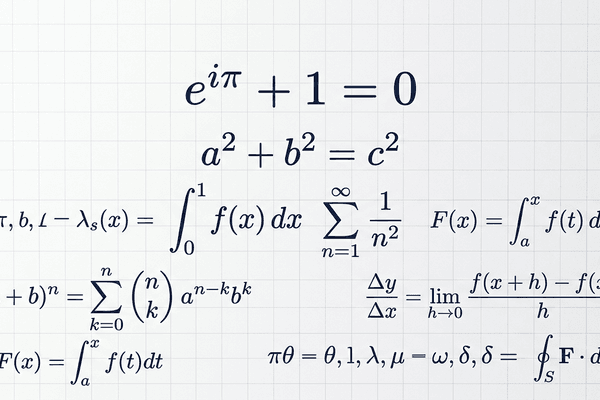
Often called the most beautiful equation in mathematics, Euler's identity connects five fundamental constants: e^(iπ) + 1 = 0. It elegantly unites exponential functions, imaginary numbers, and trigonometry.
Fermat's Last Theorem
Number Theory— Pierre de Fermat (proved by Andrew Wiles)
No three positive integers a, b, c can satisfy aⁿ + bⁿ = cⁿ for any integer n greater than 2. This deceptively simple conjecture took over 350 years to prove.
Pythagorean Theorem
Geometry— Pythagoras of Samos
In any right triangle, the square of the hypotenuse equals the sum of the squares of the other two sides. This foundational theorem underpins trigonometry and Euclidean geometry.
Gödel's Incompleteness Theorem
Logic— Kurt Gödel
In any consistent formal system strong enough to express basic arithmetic, there exist true statements that cannot be proved within the system. Furthermore, the system cannot prove its own consistency.
Bayes' Theorem
Probability— Thomas Bayes
A fundamental theorem in probability that describes how to update beliefs in light of new evidence. P(A|B) = P(B|A)·P(A) / P(B). It forms the backbone of Bayesian inference and modern machine learning.
Four Color Theorem
Graph Theory— Appel & Haken
Any map drawn in a plane can be colored using at most four colors such that no two adjacent regions share the same color. First conjectured in 1852, it became the first major theorem proved with computer assistance in 1976.
Fundamental Theorem of Calculus
Calculus— Isaac Newton & Gottfried Leibniz
The two-part theorem establishing the relationship between differentiation and integration. The first part states that every continuous function has an antiderivative; the second provides a method to evaluate definite integrals.
Prime Number Theorem
Number Theory— Hadamard & de la Vallée Poussin
The prime number theorem describes the asymptotic distribution of prime numbers: the number of primes up to $x$ is approximately $x / \ln x$. It reveals a deep regularity hidden in the seemingly chaotic sequence of primes.
Spectral Theorem
Linear Algebra— Cauchy, Hilbert & von Neumann
Every real symmetric matrix (or self-adjoint operator) can be diagonalized by an orthonormal basis of eigenvectors, with all eigenvalues being real. This fundamental result underpins principal component analysis, quantum mechanics, and the theory of partial differential equations.
Brouwer's Fixed Point Theorem
Topology— L.E.J. Brouwer
Every continuous function from a closed ball in $\mathbb{R}^n$ to itself has at least one fixed point. This topological result has profound applications in economics, game theory, and the existence proofs of differential equations.
Cantor's Theorem
Set Theory— Georg Cantor
For any set S, the power set of S (the set of all subsets of S) has strictly greater cardinality than S itself. This theorem shows there are infinitely many different sizes of infinity.